SEO Tools Tier List 2026: I Ranked 52 SEO and GEO Tools
 Paul VengeonsCo-Founder & SEO Consultant
In short
The only essential tool is free: Google Search Console. Also in S tier: Screaming Frog (£199/year), the free Detailed SEO and Wappalyzer extensions, and Wisewand for writing. Ahrefs ($129/mo) and Semrush ($139/mo) drop to B, powerful but useless without training; GEO tools sit in C, generic AI writers in D.
An SEO suite shows you data without saying what to do with it. ChatSEO, your SEO agent, decides what to do and does it for you.
Summarize this blog post with:
Which AI SEO Tool suits you best?
Answer a few questions to discover your ideal tool
🤖 Introduction
There have never been as many SEO tools as there are today, and that is exactly the problem. Between the legacy suites, the link building specialists, the semantic optimizers, the AI assistants and the new wave of GEO tools, the market has become unreadable for anyone who simply wants to know where to start.
So I sorted it out in public. This article is the tier list I filmed on my channel, where I ranked 52 SEO and GEO tools from S tier (use it) to D tier (forget it). You get the same hierarchy here, with official prices re-verified in August 2026 and the detailed reasoning the video compresses into a single sentence.
One criterion drives the whole ranking: does the tool tell you what to do, or does it leave you alone in front of a dashboard? That is what pushes very powerful tools down and free browser extensions up.
The verdict in one sentence: the only genuinely essential tool is free and it is Google Search Console; Screaming Frog (£199/year) is still the technical audit benchmark; Ahrefs and Semrush sit in B tier not because they are weak but because they need an expert to be worth anything; and GEO tools stay in C tier for as long as their visibility scores rest on prompts nobody has ever seen typed.
🔬 How I ranked these 52 tools
I have been an SEO consultant since 2020, and this ranking comes from real use, not from reading sales pages. I scored every tool on three questions, and only on those three.
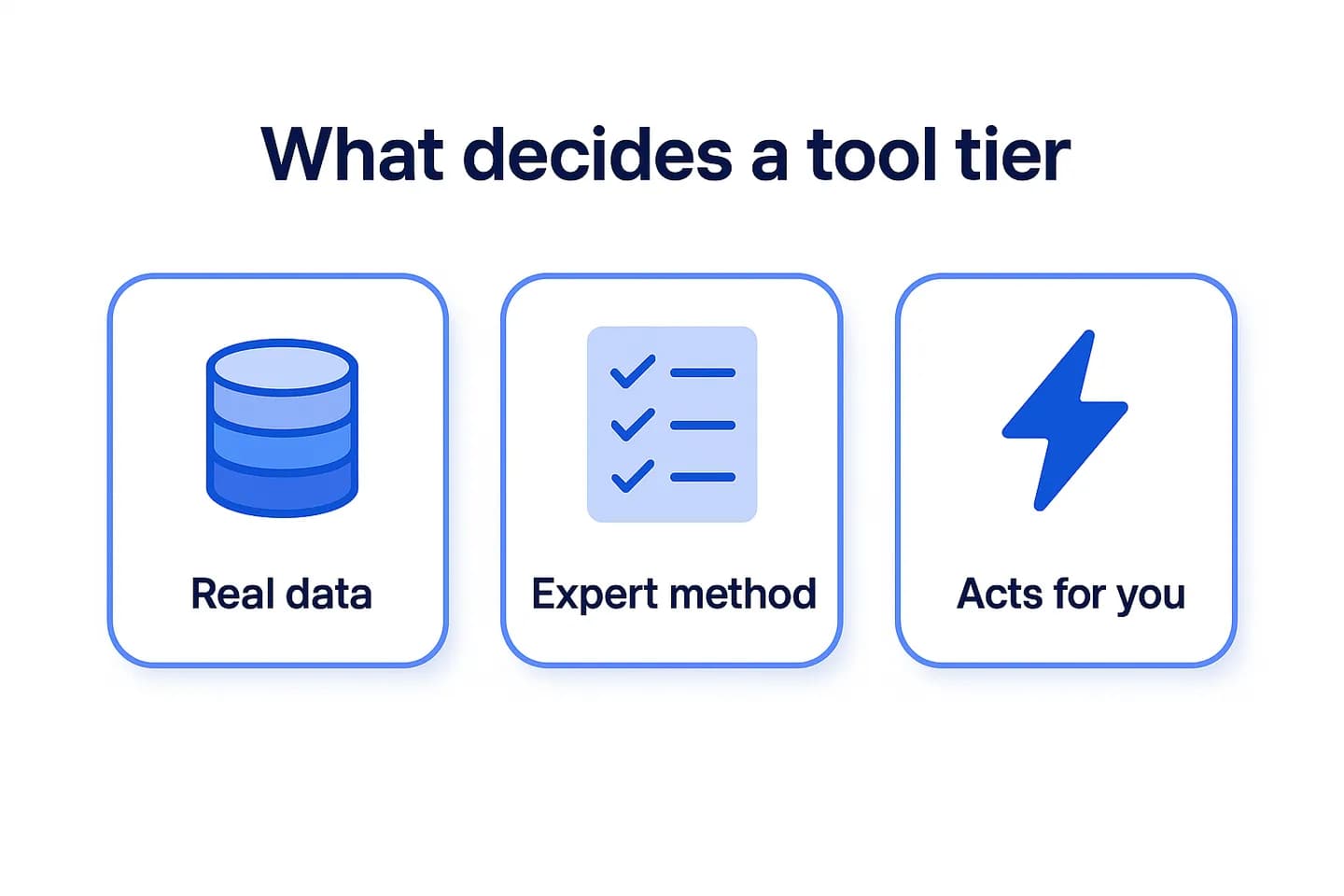
- Does it work on real data? A traffic estimate is not a measured click.
- Does it apply a consultant's method? Displaying a number is not recommending an action.
- Does it act on your behalf? In 2026, a tool that only displays is a tool charging you for your own work.
One disclosure up front: ChatSEO is my product. That is exactly why I do not crown it alone at the top of a neutral ranking. On raw data depth, Ahrefs, Semrush and Majestic are ahead, and that has to be said. ChatSEO wins somewhere else, on a specific front I detail below, and I also say who should not buy it.
My opinion in one sentence: stop hunting for the best tool, hunt for the best tool for your level. A beginner who buys Ahrefs wastes their money; a link building agency that settles for a chatbot loses its edge. Every price below was re-verified against the official pricing pages in August 2026, because they move every quarter.
The video ranks 52 tools. The table below covers all of them, with one methodological nuance: AI visibility trackers take a single row, because they are judged on exactly the same measurement flaw. They are counted as a family, not as individual brands.
📊 The full tier list in one table
| Tier | Tools | What the tier means |
|---|---|---|
| S | Google Search Console, ChatSEO, Screaming Frog, Detailed SEO, Wappalyzer, Wisewand | Install today, whatever your level |
| A | Sistrix, SEObserver, Majestic, Babbar, Haloscan, Monitorank, Oncrawl, Botify, Google Analytics, Keyword Planner, Google autosuggest, Bing Webmaster Tools, RocketLinks, Ereferer | Excellent, but on one vertical only |
| B | Ahrefs, Semrush, Moz Pro, SE Ranking, SimilarWeb, ChatGPT, Claude, Claude Code, DataForSEO, PageSpeed Insights, GTmetrix, GetFluence, Linkavista, Linkuma | Powerful, but they never tell you what to do |
| C | Paper Club, Ubersuggest, Cocolyze, Thot SEO, YourTextGuru, Surfer SEO, Google Trends, Looker Studio, Outrank, BabyLoveGrowth, GEO tools | Useful in one scenario, skippable otherwise |
| D | 1.fr, SEOQuantum, AnswerThePublic, AlsoAsked, Writesonic, Jasper, Rich Results Test | What generative AI made obsolete |
How to read it: the tier does not judge technical quality, it judges the ratio between what a tool costs you (in money and in learning time) and what it actually earns you. That is why two free extensions end up above a $139/mo suite.
🥇 S tier: the six I keep
S tier only holds tools whose payoff is immediate, with no prior training.
Google Search Console is the one tool on this list I would call mandatory. It is the only source of real data: your clicks, impressions and positions, page by page and query by query. Everything else on the market, Ahrefs and Semrush included, works on estimates. It is free, and there are things it sees that no paid tool will ever see.
Screaming Frog is still the absolute benchmark for crawling and technical audits. The licence costs £199 per year according to the official Screaming Frog pricing page, and the free version already crawls 500 URLs, which covers most small sites. The interface is intimidating for the first few days, then it becomes second nature. Its real limit: on a site with hundreds of thousands of pages you need a cloud crawler instead.
Detailed SEO and Wappalyzer are two free Chrome extensions that earn their place as much as any three-figure tool. Detailed SEO shows a page's title, meta description, heading hierarchy, links, images and structured data in one click. Wappalyzer reveals the technologies behind whatever site you are looking at, CMS included. The value-to-price ratio is infinite: they cost nothing.
Wisewand is a writing tool built by people who genuinely know SEO, and it pushes toward full automation rather than toward keyword scores. It is the only writing tool I place this high, precisely because it does not stop at semantics.
ChatSEO, finally, and I say it with the openly declared bias of its co-founder. It connects to your Google Search Console, analyses your site and follows consultant methods instead of leaving you in front of a dashboard. According to the official ChatSEO pricing page, Starter is €29/mo billed monthly and €23.20/mo billed annually (1 site), Pro €49 (€39.20 annually, 3 sites) and Ranker €79 (€63.20 annually, 10 sites), with a free trial.
Who should not buy it: agencies whose business is large-scale backlink analysis or multi-channel competitive intelligence. For those jobs, Ahrefs, Majestic or Babbar remain superior and I will say so plainly. There is also road left on full automation: other tools go further there, even if they do it worse strategically.
🥈 A tier: excellent, but on a single vertical
A tier is the specialists: they beat everyone on their own ground, and they are useless outside it.
Sistrix stands apart from the other suites thanks to its visibility index, a metric that goes further than what its direct competitors offer. SEObserver, built by Kevin Richard, aggregates Majestic data into a simplified interface, which removes the need for a separate backlink subscription: plans start at €99/mo according to the SEObserver site. Haloscan is a tool built by an SEO for SEOs, very advanced, with an MCP that plugs it straight into Claude; that is also why I would not hand it to a beginner.
On pure link analysis, Majestic remains the historical benchmark with its Trust Flow and Citation Flow metrics: Lite at €46.99/mo, Pro at €94.99/mo and API at €379.99/mo according to the official Majestic pricing page. Babbar, built by the Peyronnet brothers, is the sharpest link analysis on the French market at €139/mo according to the official Babbar site. I do not use it personally, for a reason I will own: given the choice between an ultra-precise link analysis and publishing one more page, I choose the page. That is not a flaw in the tool, it is a trade-off on my time.
Monitorank is daily rank tracking, billed per tracked keyword rather than by plan. It becomes relevant the moment you run a large site in a competitive market, where all-in-one suites only refresh weekly or monthly. Oncrawl and Botify are the enterprise cloud crawlers: if you are starting out, they are not for you.
The free side of A tier is crowded. Google Analytics earns its place mainly through conversions: configured properly, it tells you which SEO pages bring in money rather than just traffic. Google Ads Keyword Planner and the engine's own autosuggestions give you keyword ideas without spending a cent. And Bing Webmaster Tools ships a section dedicated to AI queries: the data only covers Bing and Copilot, so it is not universal truth, but these are genuinely observed queries, not invented prompts.
Finally, RocketLinks and Ereferer are the two link marketplaces I rank highest. RocketLinks is not the cheapest, but it is where the inventory and the targeting are best, AI features included. Ereferer is the way in when you want higher quality links, and therefore more expensive ones.
Results from a  ChatSEO customer
From 0 to 225 Google clicks a day
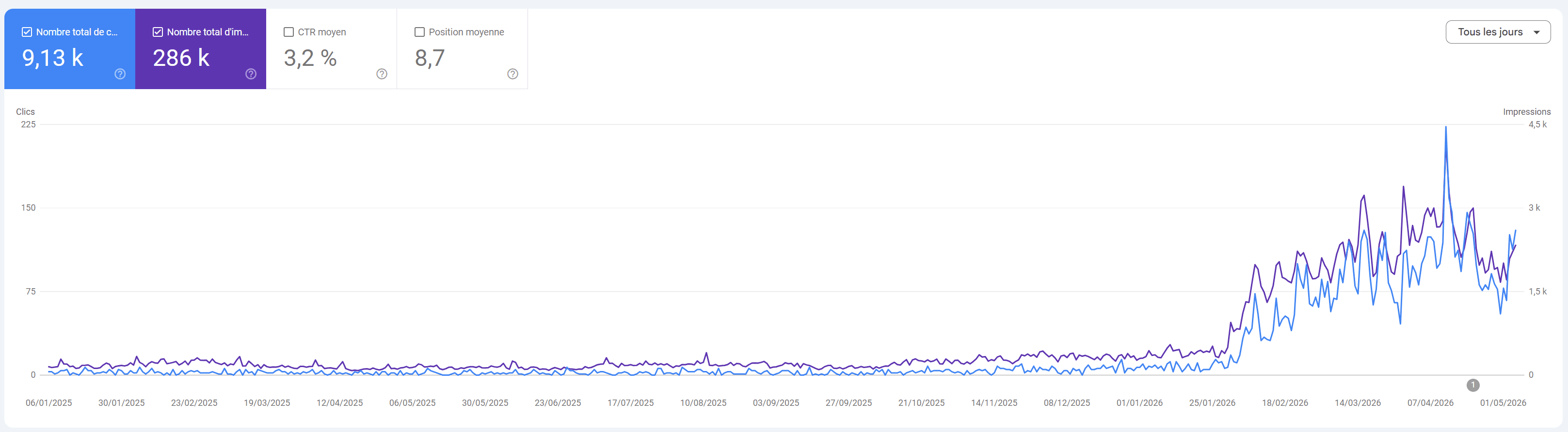
“From 0 to 225 clicks a day in a few months.”
Sébastien BRD · Founder, DLRP Express
🥉 B tier: extremely powerful, and that is exactly the problem
Ahrefs and Semrush are war machines, and I still put them in B tier. This is not a criticism of their data, which remains the deepest on the market. It is a criticism of what they demand from the user: training.
The official prices make it concrete. Ahrefs charges $129/mo for Lite, $249 for Standard and $449 for Advanced, with the $29/mo Starter plan capped by credits, according to the Ahrefs pricing page. Semrush starts at $139/mo for its SEO plan, or $117.33/mo on an annual commitment, then $199, $299 and $549 for the higher tiers, according to the Semrush pricing page.
In other words: you pay between $129 and $549 a month for a tool that will never tell you what to do with what it shows you. For an experienced consultant that pays for itself on the first audit. For an entrepreneur discovering SEO, it is a subscription to twenty tabs they will stop opening after three weeks. Both are pivoting toward AI, and this ranking will move the day that pivot lands.
Moz Pro and SE Ranking sit in the same family, with data one notch below. SimilarWeb stands out for a precise reason: it sees what SEO does not, notably paid traffic and other acquisition channels, and it is genuinely accurate there.
ChatGPT and Claude earn their place, and I mean that. For six months I delivered every single client engagement through ChatGPT, pulling data from Semrush and keeping the process in my own head. It works very well, on one condition: the expertise has to be in your head, not in the tool. Their two limits are identical: no access to real SEO data, and no consultant methodology built in.
Claude Code changes the scale as soon as it can reach your site, and plenty of practitioners build their own in-house tool by wiring it to DataForSEO for the data. If you already know SEO, it is formidable; if you do not, you are automating your own mistakes.
On performance, PageSpeed Insights and GTmetrix do the same job, and I put Google's tool first because it is simpler to use. They are good tools, simply less and less necessary: an AI assistant connected to your site optimizes your Core Web Vitals without needing a score first.
Finally, GetFluence, Linkavista and Linkuma round out the paid link landscape. Linkuma is the deliberate entry level, with backlinks starting at €7 according to the Linkuma platform, which makes it the lowest-risk place to run a first test.
🤖 GEO tools: sound logic, unsound measurement
GEO tools promise to measure your visibility inside AI answers (AI Overviews, ChatGPT, Gemini, Perplexity) and to tell you how to improve it. The problem is not their logic, which is excellent. The problem is what their score rests on.
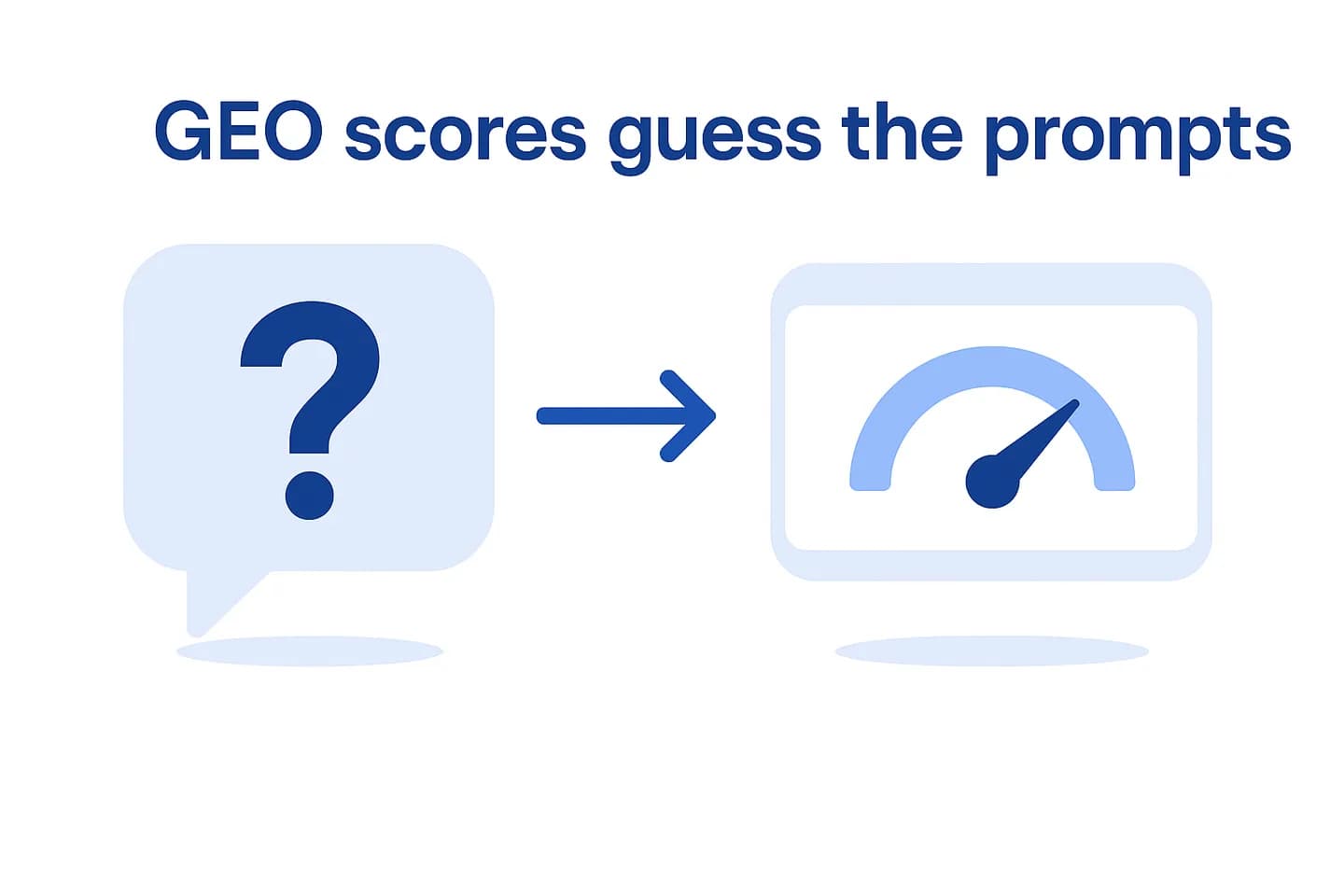
Those scores are computed from prompts the vendor picks itself and sends to the models. Nobody knows whether those prompts are actually typed by humans. In classic SEO, Keyword Planner gives you a search volume and Search Console confirms the real clicks. On the AI side there is no equivalent today: the vendor guesses, exactly the way you would guess.
An AI visibility score is not an audience measurement, it is the output of an arbitrary prompt sample. Treat it as an internal trend indicator, never as market share.
The only real usage data available today is free: the AI queries section of Bing Webmaster Tools. It only covers Bing and Copilot, so it says nothing about Gemini or Google, but it rests on observed queries rather than invented prompts. It is little, and it is already more solid.
⚠️ C and D tier: what generative AI made obsolete
D tier is almost entirely made of tools that were excellent before November 2022 and never recovered.
Semantic optimizers make up the bulk of it: 1.fr, SEOQuantum, Thot SEO, YourTextGuru and Surfer SEO. Their job is to tell you which words to insert and how often. That job mattered when Google counted words; it matters far less now that the game has moved to search intent. To be fair, these tools do exactly what they promise: it is the task itself that lost value, not their execution. Surfer SEO is the best of the family, and both Thot SEO and YourTextGuru have started integrating search intent.
AnswerThePublic and AlsoAsked generate questions around a topic. Same problem: nobody knows whether those questions are actually typed. The People Also Ask block inside Google results does the same job for free.
Writesonic and Jasper belong to the cruellest category: generic AI writers. They had a real place the day ChatGPT launched, and they lost it within months.
Google Trends and Looker Studio are in C tier for opposite reasons. Trends measures trends, not volume, and I found it imprecise in every test on brands or mid-sized queries: it probably works on very large terms only. Looker Studio remains a decent client reporting tool, but an AI assistant now produces a more tailored report in less time. Same logic for the Rich Results Test: AI tools generate correct structured data on the first pass, which makes manual validation nearly pointless.
Ubersuggest and Cocolyze close out C tier on the suite side. Ubersuggest is the cheapest of its category, with less reliable data and fewer features. Cocolyze, after extended testing, left me below Semrush and Ahrefs with no obvious compensation.
That leaves Outrank and BabyLoveGrowth, the two autopilot tools, and this is the most frustrating placement on the list. Their promise is the best on the market: you enter your site, they publish the articles and build the links. If this ranking scored marketing, they would be S tier. But it scores relevance, and their strategy produces informational articles on keywords that sometimes have nothing to do with your business. That generates traffic, rarely customers, and the articles are hard to read. I keep them at the top of C tier because the direction is right: what they lack is relevance, not ambition. I tested both in depth in the dedicated Outrank review and BabyLoveGrowth review.
💶 Prices verified in August 2026
| Tool | Official price | Verified on |
|---|---|---|
| ChatSEO | €29/mo (€23.20 annually), free trial | chatseo.app/pricing |
| Screaming Frog | £199/year, free version capped at 500 URLs | screamingfrog.co.uk |
| Ahrefs | $129/mo (Lite), $29 Starter capped by credits | ahrefs.com/pricing |
| Semrush | $139/mo (SEO), $117.33 annually | semrush.com/pricing |
| Majestic | €46.99/mo (Lite), €94.99 (Pro) | majestic.com |
| Babbar | €139/mo (SEO), €250 (API + SEO) | babbar.tech |
| SEObserver | €99/mo (Freelance), €199 (Studio) | seobserver.com |
| Linkuma | Backlinks from €7 | linkuma.com |
| Google Search Console, Analytics, Trends, Looker Studio, Keyword Planner, Bing Webmaster Tools, PageSpeed Insights, Detailed SEO, Wappalyzer | Free | Official vendors |
The number worth remembering: nine tools in this ranking are free, and they cover most of what a site under 500 pages actually needs.
🏆 Scorecard: the tool families scored
| Family | Real data | Built-in method | Acts for you | Value for money |
|---|---|---|---|---|
| Free Google tools | ★★★★★ | ★☆☆☆☆ | ☆☆☆☆☆ | ★★★★★ |
| All-in-one suites (Ahrefs, Semrush) | ★★★★☆ | ★★☆☆☆ | ★☆☆☆☆ | ★★★☆☆ |
| Link specialists (Majestic, Babbar) | ★★★★★ | ★★★☆☆ | ☆☆☆☆☆ | ★★★☆☆ |
| Crawlers (Screaming Frog, Oncrawl) | ★★★★★ | ★★★☆☆ | ☆☆☆☆☆ | ★★★★☆ |
| AI SEO assistants (ChatSEO) | ★★★★☆ | ★★★★★ | ★★★★☆ | ★★★★★ |
| Semantic optimizers | ★★☆☆☆ | ★★★☆☆ | ★★☆☆☆ | ★★☆☆☆ |
| GEO tools | ★☆☆☆☆ | ★★★★☆ | ★★☆☆☆ | ★★☆☆☆ |
| Autopilots (Outrank, BabyLoveGrowth) | ★★☆☆☆ | ★★☆☆☆ | ★★★★★ | ★★☆☆☆ |
How to read the scorecard: no family ticks all four columns. Google's tools win on real data and lose on method; autopilots win on action and lose on strategy. That is why a good stack always combines two or three families, never a single tool.
🎯 Which stack to pick for your profile
- ✅ Beginner, zero budget → Search Console, Keyword Planner, Google autosuggest, free Screaming Frog, Detailed SEO, Wappalyzer
- ✅ Entrepreneur or SMB, one subscription only → Search Console plus an AI SEO assistant plugged into your real data
- ✅ Experienced SEO consultant → Ahrefs or Semrush, Screaming Frog, Majestic or Babbar, Monitorank
- ✅ Heavy link building → Majestic or Babbar to analyse, RocketLinks and Ereferer to buy, Linkuma to test
- ✅ Large site, competitive market → Oncrawl or Botify, Monitorank, Sistrix
- ✅ You want to track AI visibility → Bing Webmaster Tools first, a GEO tool only as a complement
- ❌ Avoid as a first purchase → a three-figure suite with no prior SEO training
The rule that sums it up: start from your level, not from the ranking. The best tool in the world, in the hands of someone who does not know what to do with it, costs more than it returns.
❓ FAQ: your questions about the ranking
What is the best SEO tool in 2026?
There is no single best tool, there is a best tool per job. Google Search Console is the only genuinely mandatory one, and it is free: it is the only source of real data on your clicks, positions and pages. Alongside it, Ahrefs and Semrush remain the benchmarks for data depth, Screaming Frog for technical audits, Majestic and Babbar for link analysis.
Why are Ahrefs and Semrush only in B tier?
Because raw power is no longer the deciding criterion. They display an impressive amount of data but never tell you what to do with it: without SEO training you open twenty tabs and act on none of them. They are excellent tools for an experienced consultant and poor first tools for a beginner.
Are GEO tools worth their price in 2026?
Not yet. Their visibility score is built from prompts the vendor picks itself and sends to the models, and nobody knows whether those prompts are actually typed. The logic is sound, the measurement is a guess. Bing Webmaster Tools, which is free, at least reports AI queries genuinely observed on Bing and Copilot.
Do you need to pay for a rank tracker?
Only if you run a large site in a competitive market. All-in-one suites usually refresh positions weekly or monthly, while a dedicated tool such as Monitorank checks daily and bills per tracked keyword. On a small site the money is better spent on one more page than on one more curve.
Which free SEO tools are enough to get started?
Four are enough for the first months: Google Search Console for your real data, Keyword Planner and Google autosuggest for keywords, the free version of Screaming Frog (500 URLs) for technical audits, and the Detailed SEO and Wappalyzer extensions to read any page in three seconds. The full list is in our guide to the best free SEO tools.
Do autopilot SEO tools actually work?
The marketing promise is the best on the market, the SEO outcome is the weak point. Outrank and BabyLoveGrowth publish articles on informational keywords that are often unrelated to your business: that produces traffic, rarely customers. The direction is promising, the strategic relevance still has to be built.
How many SEO tools should you pay for at once?
One paid subscription is enough for the vast majority of sites, provided you pair it with the free Google tools. The second subscription is only justified by a specific vertical: large-scale link building or crawling very large sites.
🏆 Conclusion: what I would keep if I had to cut everything
If I could only keep three tools, they would be Google Search Console, Screaming Frog and an AI SEO assistant plugged into my real data. The first two are free or nearly free; the third replaces the hours spent turning data into decisions.
This ranking will move, and fast. Ahrefs and Semrush are pivoting toward AI, the semantic optimizers are integrating search intent, and the autopilots will eventually fix their relevance. Every one of these tools will ship a built-in chat before long: it is the logical next step, because it is how people want to work.
Take action:
- Connect your Google Search Console if you have not already, it is free and it comes before everything else
- Install Detailed SEO and Wappalyzer, two minutes and zero euros
- Pick one paid subscription, the one matching your profile in the checklist above