SEO Competitor Analysis: The 5-Step Method (2026)
 Paul VengeonsCo-Founder & SEO Consultant
In short
SEO competitor analysis means studying the sites that rank for your keywords, not your business rivals. In 5 steps: identify 3 to 5 real competitors, target their keywords in positions 4 to 10, dissect their content, examine their backlinks, prioritize the gaps. Tools: Semrush ($139.95/month) and Ahrefs ($129/month).
A list of gaps won't tell you where to start. ChatSEO analyzes your competitors and writes the highest-value pages first.
Summarize this blog post with:
Which competitor analysis tool is right for you?
Answer 5 questions to discover your ideal tool
🔬 How We Built This Method
This method comes from dozens of real competitor analyses run on client projects, not a theoretical template. For the tools cited, I pulled the official, up-to-date pricing pages (June 2026) and verified each one: monthly prices, free plans, real limits. Every figure in this article is sourced, and the outbound links point to official pages.
From experience, the number-one beginner mistake is analyzing the wrong competitors: their business rivals instead of the sites that actually rank for their keywords. A media blog can be your main SEO competitor while never selling your product. The method below fixes this from Step 1.
My one-line take: a tool doesn't do the analysis for you, it speeds up the data collection. The real value lives in the interpretation. That is why I recommend separating two moments: collection (where Semrush or Ahrefs excel) and decision (where an AI layer connected to your real data, like ChatSEO, saves the most time). I cover this honestly in the tools section.
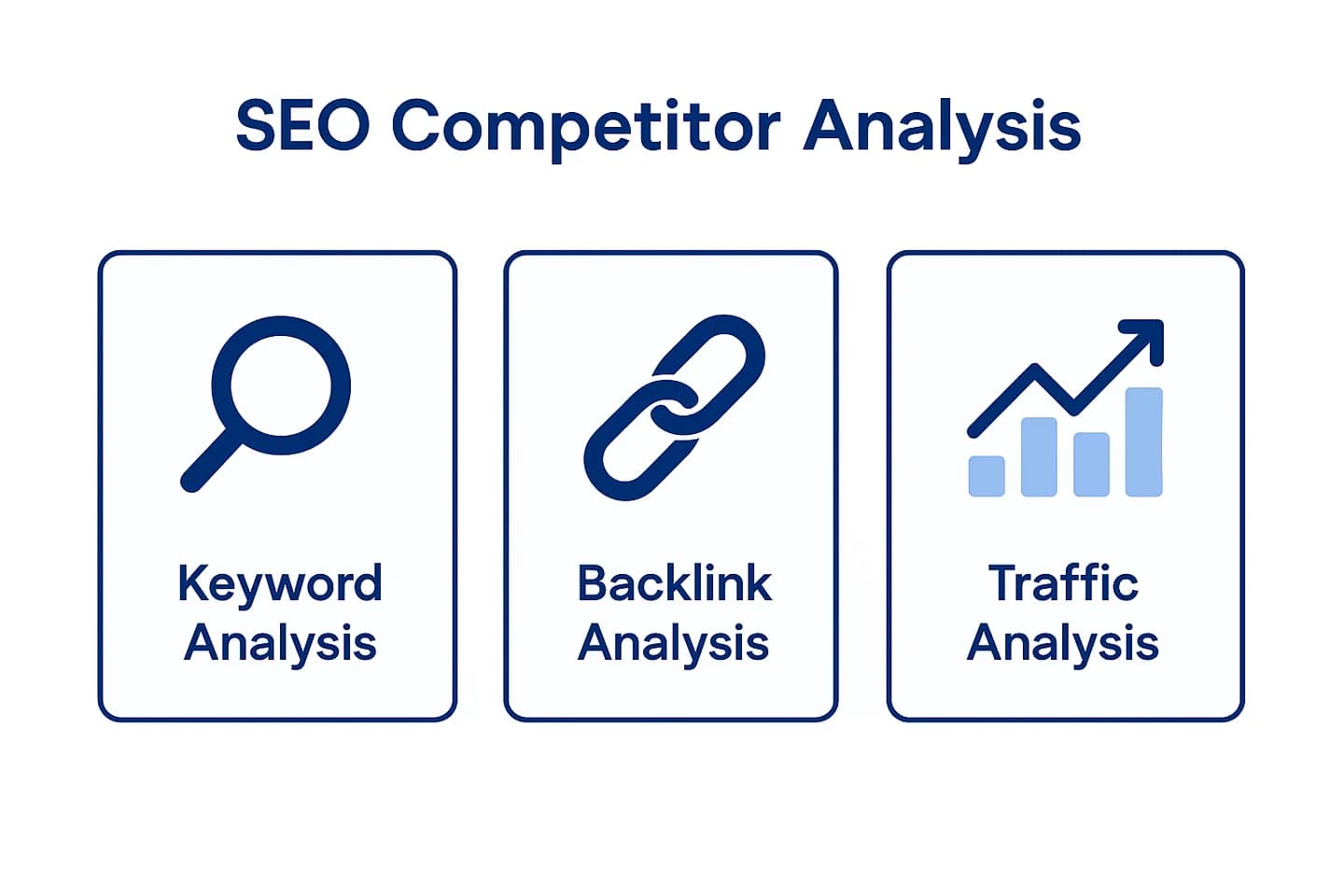
📊 Why Analyze Competitors in SEO?
Before you start, understand why this is non-negotiable. Competitor analysis stops you from starting from scratch: you build on what already works for others.
- Identify your real competitors: not every site ranking for your keywords is a business rival. Analysis separates relevant SEO competitors from mere SERP neighbors.
- Discover untapped keywords: by studying your competitors' portfolios, you spot high-volume opportunities you hadn't considered.
- Understand what Google rewards: the pages that dominate reveal the length, structure and backlink types that correlate with strong rankings in your niche.
- Accelerate your growth: instead of testing blindly, you build on strategies already validated by results and then outdo them.
🥇 Step 1: Identify Your Real SEO Competitors
The first step is listing your SEO competitors. Your SEO competitors are the sites that rank for your target keywords, not necessarily your direct business rivals. A media outlet or a comparison site can be your main SERP rival without selling the same product as you.
How to find them
Method 1: direct Google search. Type your target keywords, note the top 10 results, repeat for 5 to 10 keywords, then compile the domains that show up most often: those are your priority competitors.
Method 2: SEO tools. Platforms like Semrush, Ahrefs or SE Ranking give you the list of your organic competitors automatically from your domain. It is faster and more exhaustive than manual collection.
Expert tip: focus first on 3 to 5 direct competitors, the ones whose domain authority resembles yours. Targeting the undisputed sector leader on day one is the fastest way to get discouraged.
Try this prompt in ChatSEO:
"Who are my main SEO competitors for the keyword [your keyword]? Analyze the top 10 Google results and identify the domains that appear most frequently."
🔑 Step 2: Analyze Their Keywords
Once you've identified competitors, analyze the keywords they rank for. This is where your best growth opportunities hide.
Which keywords do your competitors target?
For each competitor, identify:
- Keywords in positions 1 to 3 (their strengths, harder to attack head-on)
- Keywords in positions 4 to 10 (your best opportunities: a well-optimized page can dislodge them)
- The search volume of each keyword
- The SEO difficulty to estimate the real effort
Build a competitive matrix
Insight: the keywords where your competitors stall in positions 4 to 10 are your priority targets. You have a real shot at outranking them with more complete content, whereas attacking a well-defended position 1 would cost ten times the effort. Focus on variants with 500+ monthly searches and medium difficulty.
Try this prompt in ChatSEO:
"Analyze the keywords [competitor.com] ranks for. Identify those where they rank in positions 4-10 with decent search volume - those are my best opportunities to outrank them."
📝 Step 3: Study Their Content Strategy
Analyze how your competitors structure their content to understand what Google rewards on your topic. The goal isn't to copy, it's to produce an objectively better page.
What to analyze
Title and H2 structure: how many H2s, what format (question, list, guide), is the keyword in the title and subheadings? A clear, exhaustive structure is often what separates position 1 from position 8.
Content length: short article (under 1,000 words) or full guide (over 2,000 words)? Match the SERP's dominant length, then beat it on depth, not filler.
Visual elements: images, videos, infographics, tables, lists? Visuals that make the topic clear at a glance improve engagement and citability by AI assistants.
Structured data: do they use FAQ, Article or Product schema? Schema.org markup can unlock rich results that lift your click-through rate.
Practical case study
Take a page on "SEO competitor analysis":
Typical competitor:
- Title: "How to effectively analyze your SEO competition?"
- Structure: 10 progressive H2s (Importance → Steps → Tools → Conclusion)
- Length: around 2,500 words
- Visuals: 5 images and 2 tables
- Schema: Article and FAQ
Your page should follow a structure at least as complete, target 2,500 useful words, include visuals and tables, and add an FAQ schema.
Try this prompt in ChatSEO:
"Analyze the page [competitor URL] for the keyword [keyword]. Compare its structure (titles, length, visuals, structured data) with my page [your URL]. What should I improve to outrank it?"
Results from a  ChatSEO customer
From 30 to 600 Google clicks a day
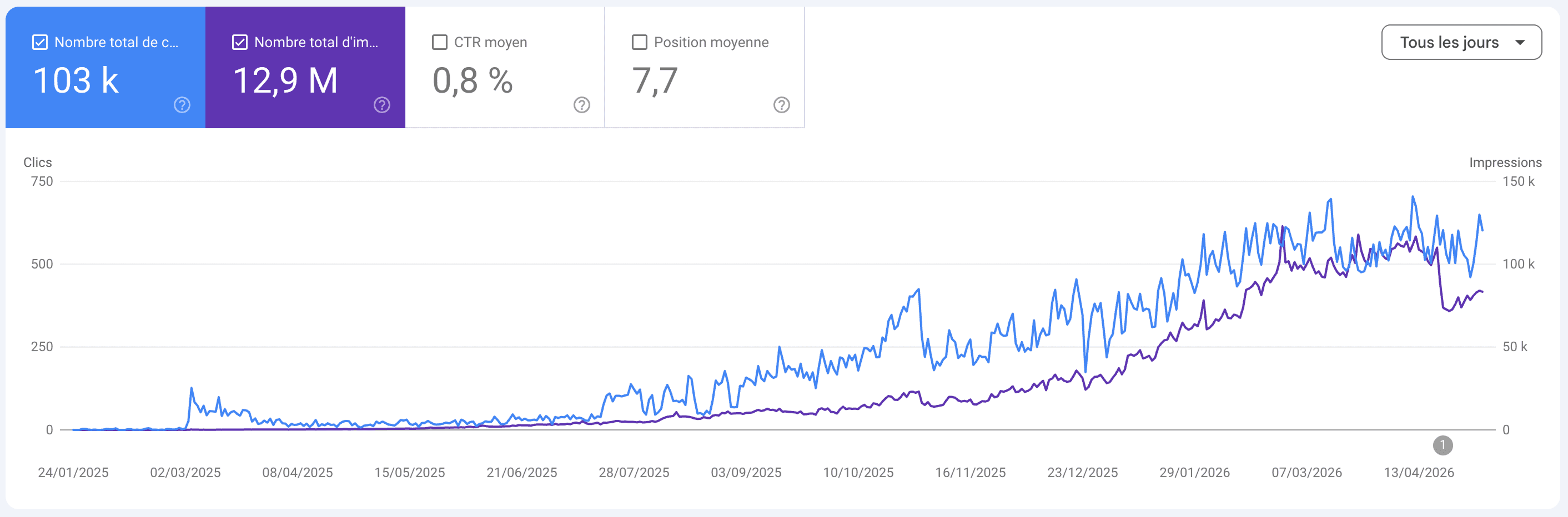

“I tripled my clicks on this site in 3 months.”
Timothée Tabary · Manager, e-commerce stores
🔗 Step 4: Analyze Their Backlink Profile
Backlinks remain one of Google's top ranking factors. Analyzing your competitors' link profile reveals their authority and your outreach opportunities.
Questions to ask
- How many referring domains point to them, and by how much do they beat you?
- Where do their best links come from (media, authority sites, partners)?
- Can you earn links from the same sources with better content?
- Are their anchor texts natural or over-optimized (a signal of their strategy, and sometimes their risk)?
Tip: don't try to copy a competitor's link profile line by line. Instead, identify the sources that are genuinely relevant to your sector and reproducible. Quality and relevance always beat raw volume.
At this stage, index depth matters. Ahrefs' backlink index exceeds 35 trillion links across 493.9 billion pages, making it the reference for link-data freshness. This is precisely where a dedicated tool justifies its price.
Try this prompt in ChatSEO:
"Analyze the backlink profile of [competitor.com]. Where are their best links coming from? What link sources could I target for my site [your-site.com]?"
🚀 Step 5: Identify and Prioritize Opportunities
This is the final and most important step: turning your analysis into concrete, prioritized actions.
Types of opportunities to spot
1. Untapped keywords: your competitors rank for keywords you don't target, with decent volume and moderate difficulty. Action: create a new page or improve an existing one.
2. Content gaps: your competitors cover a topic without exhausting it. Action: write a more complete, better-structured guide that answers every sub-question.
3. Outdated content: they rank with dated content (2020, 2021). Action: publish a 2026 version enriched with recent data to dislodge them.
4. Backlink weakness: a competitor ranks well despite few backlinks. Action: launch a targeted link-building campaign to overtake them.
Prioritize your opportunities
Use this matrix to decide objectively:
- Search volume: 40%
- SEO difficulty: 30%
- Relevance to your business: 20%
- Effort required: 10%
Result: focus your first weeks on the 3 to 5 highest-scoring opportunities, not the whole list. Spreading yourself thin is the enemy of SEO results.
Try this prompt in ChatSEO:
"Compare my site [your-site.com] with [competitor.com]. Identify keywords they rank for but I don't, content gaps, and propose a prioritized action plan to outrank them."
🛠️ The Best SEO Competitor Analysis Tools
Here are the tools I actually use, with prices verified in June 2026. None is magic: each excels at a specific job.
All-in-one tools (deepest data)
- Semrush: the most complete suite for competitor analysis (keywords, backlinks, gap analysis, audit). The Pro plan is $139.95/month, Guru $249.95 and Business $499.95. A free plan exists (10 searches/day, 10 tracked keywords), enough to get started.
- Ahrefs: the backlink reference, with an index of over 35 trillion links. The Starter plan is $29/month but credit-limited; the real features begin at Lite for $129/month, then Standard at $249 and Advanced at $449.
- SE Ranking: excellent value, with Core (from ~$103/month annually) and Growth (from ~$223/month) plans. The smart pick for freelancers and small agencies.
Specialized and affordable tools
- SpyFu: the specialist in spying on competitors' paid and organic keywords, from $39/month (Basic plan). Ideal for cross-referencing SEO and PPC.
- Moz Pro: the Domain Authority reference, Standard plan at $99/month. Handy for reporting and PR outreach.
- Ubersuggest: entry-level at $29/month (Individual plan), also available as a $290 lifetime deal. The most economical long-term for light use.
Essential free tools
- Google Search Console: free, your real ranking, click and impression data. Connect this first, always.
- Google Trends: demand trends and seasonality, free.
- AnswerThePublic: real user questions (3 free searches per day).
🏅 Overall Tool Scores
Here's how I score the main tools for competitor analysis, on what actually matters in this specific workflow:
| Tool | Data depth | Backlink analysis | Price accessibility | Path to action |
|---|---|---|---|---|
| Semrush | ★★★★★ | ★★★★☆ | ★★☆☆☆ | ★★★☆☆ |
| Ahrefs | ★★★★★ | ★★★★★ | ★★☆☆☆ | ★★★☆☆ |
| SE Ranking | ★★★★☆ | ★★★☆☆ | ★★★★☆ | ★★★☆☆ |
| ChatSEO | ★★★☆☆ | ★★★☆☆ | ★★★★★ | ★★★★★ |
Honest read: if your need is raw data and the link profile, Semrush or Ahrefs win. If your need is to quickly turn analysis into a prioritized action plan on your real GSC data, without a premium price, ChatSEO is the best AI-first pick from €29/month (Starter plan, €23/month on annual billing).
✅ Conclusion: Take Action
SEO competitor analysis is not a one-time task, but a continuous process you reassess every quarter. Here is your action plan.
- ✅ This week: identify your 5 SEO competitors, list 10 of their keywords, compare their content to yours
- ✅ This month: create 2-3 pages on the keywords you spotted, improve 3-4 existing pages, launch a small link-building campaign
- ✅ Every quarter: re-analyze rankings, keywords and backlinks, then adjust your strategy
Need help analyzing your competition? Try this prompt in ChatSEO:
"Run a complete competitive SEO analysis of my site. Identify my top 5 SEO competitors, analyze their keywords, content and backlinks. Propose a detailed action plan with prioritized opportunities to outrank them."
❓ FAQ – Frequently Asked Questions
How many competitors should I analyze?
Start with the 3 to 5 strongest competitors on your target keywords. Once you outrank them, move to the next batch. Don't spread yourself across 20 competitors at the start: pick the ones whose domain authority and content strategy resemble yours.
How often should I redo a competitor analysis?
- Every 3 months for highly competitive sectors (e-commerce, SaaS, finance)
- Every 6 months for less competitive ones
In parallel, monitor your 10 priority keywords every month along with your competitors' new content.
Should I copy my competitors' strategy?
No. Use their strategy as inspiration, but build your own angle. The goal is to do better: more complete, more up to date, better aligned with search intent. Google rewards originality and depth, not duplication.
Which tool should I choose for SEO competitor analysis?
For the deepest raw data, Semrush (Pro at $139.95/month) and Ahrefs (Lite at $129/month) are the references. To start with no budget, combine Google Search Console and Semrush's free plan (10 searches/day). To turn analysis into an action plan on your own data, ChatSEO from €29/month (Starter plan, €23/month on annual billing) connects your Search Console and prioritizes opportunities.
How do I know if an SEO opportunity is worth it?
Use the prioritization matrix: search volume (40%), SEO difficulty (30%), business relevance (20%), effort required (10%). Target a score above 70/100 and tackle 3 to 5 high-impact actions first.
My competitors rank better than me. How do I outrank them?
Three levers: content (more complete, better structured, aligned with intent), backlinks (a more relevant and higher-quality link profile) and long tail (the longer-tail variants where competition is weaker, to win positions faster).
📚 Useful Resources
- Best Competitor Analysis SEO Tools - the full tool landscape
- Best AI SEO Tools in 2026 - the AI-native options
- Semrush vs Ahrefs - the two heavyweights head to head
- Ahrefs vs SimilarWeb - SEO execution vs traffic intelligence
- Free Ahrefs Alternative - backlink research without breaking the bank
- Best Free SEO Tools - get started with no budget